
Software Can’t Dig
Everyone’s debating whether SaaS or “Services as Software” wins. Nobody’s asking the harder question.

I need to get something off my chest.
If I hear one more person at a dinner party say “SaaS is dead” with the confidence of someone who just discovered fire, I’m going to lose it.
SaaS is not dead. Atlassian just printed $5B+ in cloud revenue growing at 26%, with remaining performance obligations up 44%. Mike Cannon-Brooks (co-founder of Atlassian, who has been building enterprise software for 24 years, which is longer than most of the people tweeting about this have been alive professionally) called the narrative “ludicrous.” Anish Acharya at a16z called it “a silly story.” Scott Galloway on Prof G Markets called it “panic selling.”
Software is fine. Take a breath.
But here’s where it gets interesting. I think 90% of the hot takes fall apart while the remaining 10% accidentally stumble onto something profound.
I’ve spent 18 years running a services company. I have some thoughts.
The Shovel and the Hole
There’s a famous line from Harvard Business School professor Theodore Levitt: “People don’t want to buy a quarter-inch drill. They want a quarter-inch hole.” The customer doesn’t care about the tool. They care about the outcome.
This has become the central metaphor in the SaaS vs. SaS debate (adapted from drills to shovels, but the logic is the same). Let me make it explicit:
SaaS (Software as a Service) = selling the shovel. You build a tool and sell access to it. The customer still has to do the digging. They use your platform to do their own bookkeeping, run their own FP&A, manage their own close. You get paid per seat, per month, regardless of whether they dig a great hole or a terrible one.
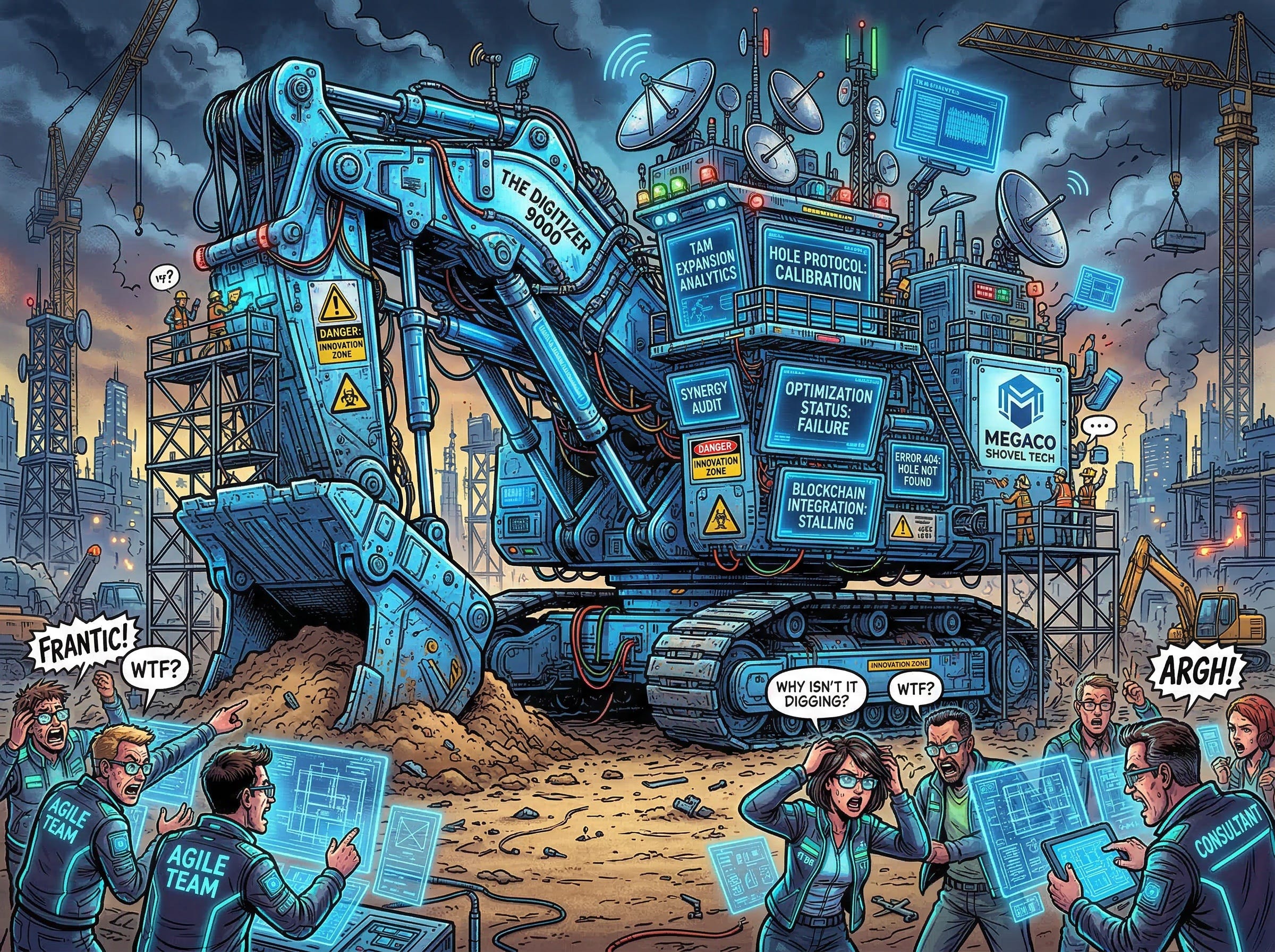
SaS (Services as Software) = selling the hole. You don’t sell the customer a tool. You sell them the finished outcome: the books are closed, the forecast is built, the reconciliation is done. Behind the scenes you’re using AI agents and software as your backbone, but the customer never touches any of it. They just get the result. You get paid per outcome or per unit of work completed, not per seat.
The economic logic is seductive. If you’re selling the hole, you can charge based on the value of the hole (which is high, because it replaces an entire labor cost) rather than the cost of the shovel (which is low). Revenue per customer goes way up. SaS businesses also compete differently. Instead of going up against other software, they compete with agencies, consultancies, and BPOs. The TAM expands because you’re addressing the full services market, which dwarfs software spend.
This is the part the VCs are excited about. And they’re right to be. The $1 trillion-plus professional services market is legitimately where AI creates the most disruption. IT spend is only 8-12% of enterprise budgets. The other 90% is people and process. If you’re a VC looking for your next trillion-dollar opportunity, why would you point your “innovation bazooka” (Acharya’s term) at rebuilding payroll when you could go after the other 90%?
So far, so good. I’m nodding along.
Now let me tell you what annoys me.
“Services as Software” is a term invented by people who have never run a services business, to explain services businesses to other people who have never run a services business. It’s VC-to-VC language. It exists because software people need a framework to understand something that services people have always just called... work.
Every services company in history has been “selling the hole.” Your plumber sells you working pipes, not a wrench rental. Your accountant sells you clean books, not access to a spreadsheet. The only people who find this framing revelatory are software people who’ve spent their entire careers selling shovels and are now realizing that the hole is where the money is.
And calling it “Services as Software” isn’t just redundant, it’s backwards. It centers software as the identity and frames services as the novel twist. As if the hard thing is the technology. As if the great insight is “what if software... but it does the work?” The hard part was always the service. The judgment, the relationship, the context. Technology is a commodity input now. Calling it “Services as Software” is like calling a restaurant “Food as a Service.” It’s a label for something that already existed. At this rate, we’re one hype cycle away from someone coining “Services as a Service” and raising a Series A on it.
Nobody calls it a “smartphone” anymore. It’s just a phone. Every phone is smart now. “Tech-enabled services” had a brief moment of usefulness, back when some services companies used technology and others didn’t. That moment is over. Every services company that intends to survive uses AI. The label is meaningless now. It’s table stakes.
But fine. I’ll engage with the premise. Because underneath the dumb acronym, there is a real insight: the boundary between software and services is collapsing. That part is true. And the most interesting question (the one almost nobody is asking) isn’t which model wins. It’s who is better positioned to cross the line when the wall crumbles.
This is where the takes go off the rails.
The Part Nobody Wants to Talk About
The implicit assumption in every “SaS is the future” argument is that software companies will be the ones delivering this. That Salesforce or some well-funded startup will simply... start doing the work. Ship the product, then ship the outcome. Flip the switch from selling shovels to selling holes.
I’ve been selling holes for 18 years. Trust me — it doesn’t work like that.
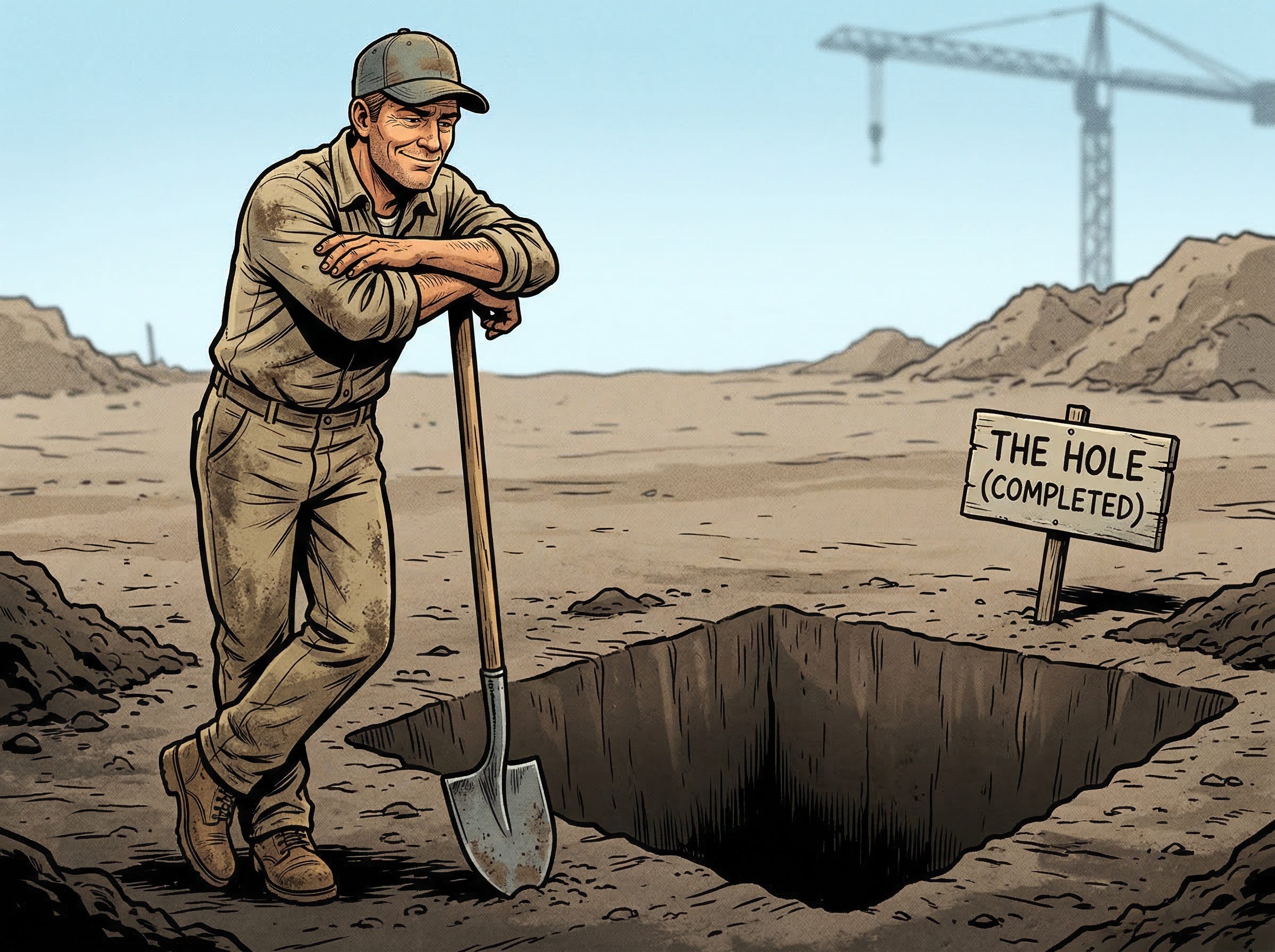
Running a people-centric company is a fundamentally different discipline from running a software company. You can’t bolt it on as a feature or treat it as a go-to-market pivot. It’s a completely different organism with different DNA, different incentive structures, different hiring profiles, different management rhythms, and a completely different tolerance for the messy, contextual, human reality of being accountable for someone else’s outcomes.
Software companies are built to ship product. They optimize for release cycles, feature velocity, and scalable unit economics. The whole organizational architecture (how they hire engineers, how they structure comp, how their boards evaluate performance) is designed around building something once and selling it many times.
Services companies are built to sit in the room. They optimize for context, relationships, judgment, and the kind of accumulated institutional knowledge that makes the difference between a good recommendation and the right one. You’re deploying people who know things into situations where knowing things matters.
These are not the same thing. They are not adjacent things. They are, in most ways, opposite things.
It’s neither in their nature nor their nurture.
Don’t take my word for it. Bret Taylor (former co-CEO of Salesforce, now building Sierra, one of the fastest-growing AI agent companies) recently described on the Uncapped podcast what he calls the “strategy tax.” When a major platform shift hits, everything that made incumbents strong becomes an anchor. There’s a product strategy tax: you can’t start from scratch because you have existing assets to protect. A business model strategy tax: revenue recognition changes, sales comp changes, CapEx becomes OpEx. And an organizational strategy tax: you can’t let your business collapse overnight while you figure out the new model.
His line was brutal: “It’s so easy for someone in Silicon Valley to say ‘just pivot.’ If you’re a public company, you have to go in front of your investors every quarter and say ‘I know our revenue went off a cliff, but trust me.’ You don’t survive that.”
And there’s a layer Taylor identifies that the SaS crowd completely ignores: SaaS revenue isn’t just revenue. It’s contracted, predictable, ratable revenue on 12-month terms. That predictability is the entire reason SaaS multiples are high. The moment you start moving toward outcomes-based or services-like pricing, you lose the predictability that justifies the multiple. It’s not just that margins change. The quality of the revenue changes. And revenue quality is what drives valuation.
So even if a software company wanted to cross the bridge into services, they’d face compounding structural resistance. Their product architecture resists it, their business model resists it, their org resists it, and their contracted revenue base actively punishes them for trying.
Which brings us to the math.
The Cap Table Problem
Their cap tables won’t let them.
Software companies are valued on 70-80% gross margins. Their investors underwrote those margins. Their employee equity expectations are calibrated to those margins. Their burn math, their runway calculations, their entire financial identity is built on the premise that the marginal cost of serving the next customer is approximately zero.
Most services businesses run on 30-50% gross margins on a good day. The marginal cost of serving the next customer is... hiring another person.
Try telling your Series C investors — who valued you at 15x revenue based on software margins — that you’re pivoting to a model where gross margins drop by half. Try explaining that to your engineering team, whose equity is priced against a SaaS multiple. Try explaining it to your board, which was promised capital-efficient growth and is now being asked to fund a people-intensive operation with fundamentally different economics.
This isn’t a theoretical problem. It’s a math problem. And math doesn’t care about your hot take.
KPMG found this out the hard way from the other direction. They negotiated a 14% cut in audit fees from Grant Thornton by arguing that AI should make their auditor more efficient. Fees dropped from $416K to $357K. Congratulations: KPMG just handed every audit client in the world the playbook to squeeze their own accountants. When your clients start telling you that AI should make you cheaper, margin compression isn’t a theory. It’s a Tuesday.
The Graveyard of “Services as Software”
You don’t have to take my word for any of this. There’s a graveyard.
ScaleFactor. Indinero. Bench. And now Botkeeper, $90 million in venture funding, shut down over a weekend in February 2026. Every one of these companies raised capital on the exact thesis we’re discussing: use technology as the backbone, deliver the outcome, charge per task instead of per seat. Software-like margins from service delivery. Sell the hole, not the shovel.
They all died.
When your entire product is the commodity layer, you are the commodity.
I have a particular relationship with this story. In April 2020, an investor doing diligence on Botkeeper reached out to me. They wanted to understand how we did bookkeeping, whether automation was changing the game. Here’s what I wrote back:
“As someone who has a lot to gain from automation, I have a POV. Problem is, automation is not an either/or thing, it’s a gradual tech-enablement of a human-centric service. Put another way, we are all on an automation continuum and despite the efforts and $ raised by Bench, ScaleFactor and Pilot, we’ve yet to see a major step-up in efficiency/quality.”
I was more direct on the phone call. I told them it was a race to the bottom, that the economics would never work because every improvement in AI that made the service cheaper would also make it easier for the next startup (or the incumbent ERP) to offer the same thing.
They wrote the check anyway. The venture math was too seductive.
When your moat is the automation itself, your moat is temporary. Botkeeper’s CEO cited coding 80% of transactions with 98% accuracy. Didn’t matter. QuickBooks added similar capabilities as a feature. When your entire product is the commodity layer, you are the commodity.
And the timing is cruel. By the time Botkeeper had genuinely sophisticated AI capabilities (which, by all accounts, they did by late 2025) the market had moved on. A former employee described the AI Botkeeper pioneered as “a butter knife to a steak knife” compared to what generative AI could do. The technology moat didn’t just erode. It got lapped.
I respect what Botkeeper built. They saw the future before most of the industry did, and they had the guts to bet on it. The failure wasn’t vision. It was the structure around the vision — the cap table, the margin expectations, the clock that venture funding puts on every decision.
The pattern across all of these failures is identical. They tried to underwrite services delivery against a software cap table. Raised at software valuations, promised software margins, then discovered the business they were actually running had services economics. The gap between what their investors needed and what the business could deliver is what killed them. Not the technology, not the market, not “macro-economic shifts.” The math.
“But AI Will Give Us Software Margins!”
I can hear the counterargument already, because I’ve heard it at every conference for the last two years:
“Chris, you’re wrong. AI agents will eventually do 80% of the cognitive work. The human layer becomes razor-thin. Gross margins migrate from 35% toward 65-70%. Software companies can enter services without the margin degradation. The cap table objection dissolves.”
It’s a good argument. It’s also wrong.
If AI makes it cheap and easy to deliver outcomes, then barriers to entry drop for everyone. Every software company, every startup, every consulting firm, every accounting practice with a Claude subscription can spin up AI-powered services. Supply floods the market, margins compress. That’s not my opinion. That’s Econ 101.
The fantasy of “software margins on services delivery” assumes you’re the only one who figured out AI. You’re not. Nobody is. The models are commoditizing fast. Lemkin himself wrote that prompts are portable and that 50-80% of migrating between AI agent vendors is just copying and pasting a prompt. If your moat is the AI, you don’t have a moat.
What actually determines margin structure in the long run is defensibility. Proprietary data, embedded trust, client context, domain expertise accumulated over years. Companies with those assets will command premium margins. Companies without them will compete on price until they die or get acqui-hired. Today, those are overwhelmingly services-company assets. Not software-company assets. Will that always be true? No. As the wall between software and services collapses, the bridge runs both ways. Software companies will get better at building relationships and accumulating context. But that takes years, and the venture math doesn’t give you years. The services companies that are adding technology right now have a head start that compounds, and the window to catch up is narrowing, not widening.
Look at the Botkeeper graveyard again. Every one of those companies promised software margins. None achieved them. The moment a client can get the same automated output from QuickBooks or a new startup for less money, the margin structure reflects the competitive reality of the services market, not the aspiration of the software market.
There’s also the demand side. KPMG got its audit fees cut 14% by a client who argued AI should make auditors cheaper. That was with early-stage AI. Wait until CFOs have real benchmarks for what AI-powered services delivery should cost. Margin compression won’t just come from competitors. It’ll come from buyers who understand the economics better than the VCs do.
I believe our dependency on humans will evolve dramatically over time. I’m planning for it. But there’s a difference between how we plan for it and how a VC-backed SaS startup plans for it. We can let that transition happen at the pace our clients can actually absorb, reinvesting efficiency gains into quality and capability. We can compound. A profitable services business running at 15-20% EBITDA can underwrite that curve patiently.
A startup with $90 million in preferred equity and a board expecting software margins next year? They can’t. Every efficiency gain has to go straight to the margin line to justify the valuation. There’s no room for patience, no room for the messy reality that organizational adoption takes time, that clients resist change, that the last 20% of automation is harder than the first 80%.
That’s the real structural advantage of being a services company in this transition. Not that you’re better at AI or have more engineers. You can afford to be patient while the venture-backed competitors burn through capital trying to force a margin structure the market won’t support.
The Bridge Goes Uphill
I think history will validate this: it will prove far easier for services companies to add software than for software companies to add services.
Think about what a services company already has that a software company needs to build from scratch. Client relationships where you’re in the Monday standup and you’ve seen three CFOs come and go. Operational context that tells you the spike in Q3 expenses was the CEO’s side project, not a strategic pivot. Organizational patience for the messy, long-cycle, relationship-dependent reality of being accountable for someone else’s outcomes. You can’t build that in a sprint. You can’t acquire it in an acqui-hire. It compounds over years.
And now, for the first time, services companies can add a technology layer that gives them real leverage. AI doesn’t replace the embedded relationship. It multiplies it. The context that used to live in one CFO’s head can now live in a platform that compounds across hundreds of clients. Not software eating services. Services absorbing software.
Aaron Levie recently laid out a framework for how AI disrupts different categories. His most interesting one: services that never had a software complement at all, where the work has always been done by humans with generic tools. Finance services is exactly this. There was never a purpose-built system of record for embedded finance work. We used ERPs, spreadsheets, apps, and judgment. Now there can be one, and it’ll be built by the people who’ve been doing the work. Not by a software company parachuting in.
Accenture clearly sees this too. They struck a deal with Anthropic built entirely around “forward-deployed engineers” — people embedded inside enterprises to help them actually use AI. Not dashboards. Not self-serve onboarding. People in the building. We’ve been running that playbook for 18 years. We just called them “embedded teams.”
Jason Lemkin said it best: prompts are portable. Relationships are not.
What This Actually Means
The “SaaS is dead” narrative is tired. The “Services as Software” framing is half-right. And the assumption that software companies will naturally be the ones to deliver outcomes is the part that’s going to age the worst.
I founded a company 18 years ago that has been selling outcomes the entire time. We just didn’t have the buzzword. We didn’t pivot to services, we’ve always been services. What’s changing now is that AI is profoundly reshaping how we build solutions for our clients, connecting institutional knowledge across hundreds of engagements in ways that weren’t possible even two years ago. The technology isn’t (yet) replacing the people in the room. It’s making them dramatically better.
I’d rather build that way — patiently, with great clients and real margins — than chase software multiples on a services business that can’t support them.
Brilliant!